
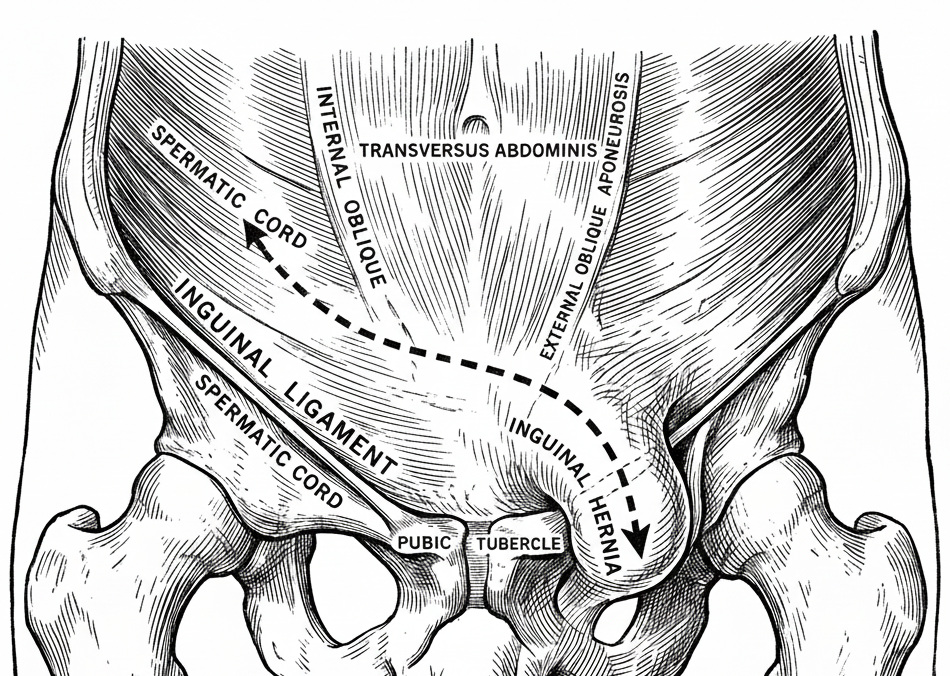
What is an inguinal hernia?
An inguinal or groin hernia is a common problem that is a result of a laxity or weakness in the groin area resulting in fat or intestines from the inner abdominal cavity protruding through muscle layers which can cause a visible bulge and/or pain. It likely has a genetic component and also is correlated to pressure and certain lifting movements.
Are there non-surgical options?
Non-surgical treatments include observation, and hernia belts. Unfortunately at this time, there is no non-surgical cure for a hernia.
Small hernias can be kept at bay by avoiding constipation, heavy-lifting, and using proper technique when lifting by engaging the entire core. Furthermore core-exercises including the obliques and groin can help bolster the surrounding muscles.
Most experts agree that having a skilled and experienced surgeon is most important with surgical success long-term. Having said that, published rates of recurrence in general for inguinal hernias range usually from 1 to 10%, with non-mesh repairs having a slightly higher recurrence.
In general for mesh repairs, recurrence rates are expected at 1-3% and for non-mesh repairs, that number climbs slightly to 1-5%. Our rates are lower, but remember most data is limited because the true follow-up for hernia recurrence is on the scale of a lifetime (as opposed to 5 and 10 year follow-ups as are commonly reported).
MYTH: All hernias must be repaired as soon as possible
Many small and asymptomatic hernias are safe to observe (“watchful waiting”) and have a low risk of serious complication (probably less than 1% per year). Hernias that are painful or growing would more likely warrant repair.
MYTH: Open surgery is much more painful than robotic surgery
Hernia surgery performed by expert surgeons is generally well-tolerated regardless of the technique. Many of our patients with open repairs do not use strong pain medicines for more than a day, and some do not even use any strong pain medicines.
MYTH: Robotic surgery is always best
Different hernia surgery techniques have pros and cons which are unique to each patient and their situation. We do not only do one technique, but rather seek to employ the best, least invasive, and safest technique based on a patient’s particular anatomy and physiology.
The following are principles of “prehab” (preconditioning and optimization prior to surgery) for hernia surgery:
Get to goal weight — a rough guide would be BMI 25 or under (BMI calculator site).
This is very important with decreasing recurrence rates, especially with no-mesh repairs.
Achieve this with:
i. Diet
ii. Healthy lifestyle
iii. Exercise (cardio + strength)
Core strength:
Strengthening the muscles improves the tissue quality at time of surgery.
Muscles to focus on in the core:
i. Rectus abdominis
ii. Obliques
iii. Balance the above with the erector spinaeStretching is good to do after exercises.
We recommend doing 5-10 minutes of core exercises daily (more is better, but this is quite sustainable in the long-term).
Suggested exercise routine:
Utilize total body movements, don’t over-stress joints.
3 sets of 10-15 reps:
Pushups: if too difficult, other options include putting knees down, or using the wall or a counter to do standing pushups.
Body weight squats: keep your back straight, and your knees behind your toes.
Cardio: Do regular cardio exercise. Anything is better than nothing. Many recommendations say to do about 30 minutes 5 days per week. But even 15 minutes a day a few times a week is better than nothing! Take the stairs, take a hat and park further away and walk more, etc.
Avoid toxic intake:
Stop smoking! Our practice can help you stop smoking using nicotine replacement, and behavioral counseling. Vaping and similar things are also damaging to the lungs and not recommended. We want your oxygen levels high in the tissues after surgery!
Don’t drink alcohol too much; the practice can help you with this. Too much alcohol makes for fatty livers, and starts the road to liver failure.
Get off illicit drugs. They have many adverse health effects; the practice can help refer to other practices and rehabs. Out of the marijuana options available, edibles appear to be best.
General health optimization:
Chronic medical conditions should be well controlled.
Diabetics should maintain good sugar control (HbA1c <7, or morning finger sticks around 100 or less).
HIV patients should have CD4 counts above 200.
To help achieve these goals, please refer to our healthy lifestyle page, other resources such as healthy diets, and core exercise plans such as pilates. Also of note, the Hernia Coach is available to help patients and has a very informative website.
Here are links to interesting reading:
Inguinal hernia papers:
The Shouldice technique for the treatment of inguinal hernia
Long Term Outcomes after Surgery for Inguinal Hernia: a Retrospective Cohort Study Comparing Outcomes of Desarda and Lichtenstein Repairs with Three Years of Follow-Up
Desarda versus Lichtenstein inguinal hernia repair: A meta-analysis of randomized controlled trialsShouldice technique versus other open techniques for inguinal hernia repair